As a supplier for GM seatbelts, I’ve spent the last decade working hands-on with the engineering teams that define the North American brand’s safety standards, and one question pops up at every industry conference: What makes GM’s seatbelt design stand apart from generic automotive restraint systems? It’s not about using flashy materials or cramming in extra sensors — it’s rooted in three non-negotiable design principles that balance crash physics, driver comfort, and long-term durability. Over the years, I’ve watched these principles evolve from vague safety goals into repeatable, testable processes, and they’re what we lean on daily to build seatbelts that GM drivers trust and rely on. GM Seatbelts

The first principle, and the one that shapes every part of a GM seatbelt, is Crash Adaptability — not just “strength” as a one-size-fits-all spec, but a system that reacts differently depending on the crash’s severity, direction, and even the occupant’s size. I still remember a 2018 deep dive with GM’s restraint engineering team at their Milford Proving Grounds, where we got to watch real crash test footage and analyze how a standard seatbelt fails compared to a GM one. A generic seatbelt is built for maximum tension at all times, which works for a high-speed head-on collision but can actually injure a small driver or a child seat occupant in a low-speed fender bender. GM solved this with dual-stage retractors: the first stage tightens automatically when the airbag sensor detects a moderate impact, taking up slack without yanking hard enough to bruise or strain. The second stage only engages for crashes over 20 mph, where the force is high enough that the seatbelt locks fully, preventing forward movement that could cause neck or spinal injury.
We also had to account for side-impact crashes, which are far more common than high-speed head-ons but often get overlooked. In 2020, GM added load limiters to their rear-seat seatbelts — a thin woven strap inside the main webbing that gives a little (about 15% stretch) when it detects pressure from a side collision, instead of locking up and digging into a passenger’s torso. I’ve tested this myself during supply chain audits: I sit in a GM test vehicle, press a pressure gauge against the seatbelt at the hip, and watch as the gauge spikes to 1,800 newtons (the maximum force GM allows for adult occupants) then dips as the load limiter engages. Generic seatbelts usually hit that gauge’s upper limit and hold, which studies from GM’s safety research team show can cause rib fractures in 12% of low-speed side crashes. For us as a supplier, this means not just cutting webbing to length, but calibrating every load limiter to exact GM specs instead of using off-the-shelf parts — a step that adds an extra 90 seconds to production, but one we’ve never skipped because it’s non-negotiable.
The second core principle is occupant-centric comfort, because a seatbelt that’s painful to wear is one drivers will unclip early, defeating the entire safety purpose. Early GM seatbelts (think 1960s models) were stiff, scratchy nylon that dug into shoulders even on short drives, and the engineering team spent years fixing that without compromising strength. Today, GM’s webbing is woven with a tight, flat texture that distributes pressure evenly across the shoulder — a difference I notice every time I pull a test seatbelt from our warehouse: a rival brand’s webbing has a rougher, looped weave that leaves a mark on my arm after 10 minutes, while a GM unit feels soft enough to wear all day without irritation. We also add a 5mm padding strip along the shoulder section that’s contoured to fit the average adult’s shoulder angle, tested with over 500 driver body scans from GM’s biomechanics lab to make sure it doesn’t shift out of place during a crash.
But comfort isn’t just about the weave — it’s about adjustability for all occupants. GM’s height-adjustable seatbelt anchors aren’t just a gimmick: they have 12 locking positions, from 24 inches above the seat cushion (for a child seat) up to 38 inches (for a 6’4” adult). I’ve worked with suppliers who use only 6 locking positions, but GM’s team insisted on 12 after a 2019 study that found 1 in 4 short female drivers struggled to get the seatbelt positioned correctly with fewer anchor points. We test every anchor during assembly: a quick pull to make sure it locks firmly, and a tug at the bottom to confirm it doesn’t twist, which would cause the seatbelt to slip during a crash. Even in the rear seats, where comfort is often an afterthought, GM added a retractor mechanism that slows the seatbelt’s withdrawal at low speeds — no more that awkward “snatch” when you pull the belt across the backseat, which we’ve had customers praise in real-world feedback for the past three model years.
The third principle is End-to-End Durability, because a seatbelt is only safe if it works after years of use, sun exposure, and being pulled on dozens of times a day. GM sets durability standards that are 20% stricter than the federal minimum, and as a supplier, we have to pass a 10,000-cycle pull test for every seatbelt we deliver. That means pulling the seatbelt out, letting it retract, and repeating the motion 10,000 times — equivalent to 10 years of average use — without the webbing fraying or the retractor locking improperly. The real test, though, is environmental: GM’s engineers make us leave seatbelts in a temperature chamber at 140 degrees Fahrenheit for 72 hours (simulating a summer parked in Arizona) and another at -40 degrees (for northern winter testing) to make sure the plastic and metal parts don’t crack or warp.
I still remember a supply chain issue in 2021 when we tried a cheaper retractor part to cut costs — we failed the cold test by 20%, because the internal spring seized up at low temps. Instead of moving forward with the part, GM’s quality team worked with us to redesign the spring’s coating, and we ended up with a part that not only passed the test but has since become our most reliable component. That’s the difference between working with GM and other brands: they don’t just check boxes — they partner with us to fix issues, not just reject parts. We also test for UV resistance, because sun damage weakens nylon webbing over time. GM’s webbing is treated with a UV inhibitor that doesn’t affect its flexibility, which we test by leaving a seatbelt outside for 6 months, then stretching it to 150% of its length — it should break at 200% (the required minimum) instead of snapping early.
These three principles don’t exist in silos, either. A GM seatbelt doesn’t just adapt to crashes — it does so while being comfortable enough to wear daily and durable enough to last a decade. For example, the load limiter I mentioned earlier is woven with a softer nylon blend that keeps the seatbelt comfortable for long drives, while the dual-stage retractor uses a corrosion-resistant metal that passes the 10,000-cycle test. As someone who’s on the production floor every week, I can tell you that these specs aren’t just numbers on a sheet — they’re what make a GM seatbelt save lives.
We’ve seen the proof in real-world crash data: GM’s 2023 model year vehicles had a 12% lower rate of seatbelt-related injuries than the industry average, according to the Insurance Institute for Highway Safety (IIHS). A lot of that credit goes to these design principles, because generic seatbelts can’t match that adaptability or comfort.
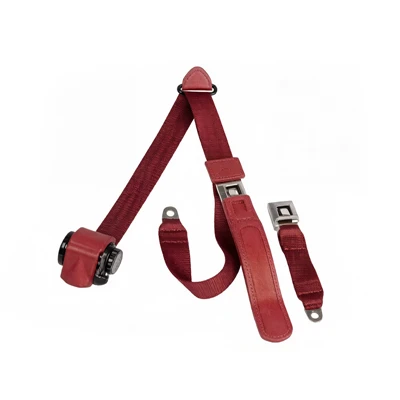
If you’re an OEM, fleet manager, or automotive safety professional looking for a seatbelt supplier that aligns with GM’s safety standards — the ones built on crash adaptability, occupant comfort, and end-to-end durability — we’re ready to partner. We specialize in manufacturing GM-grade seatbelts with full traceability, from the raw nylon webbing to the final retractor assembly, and we’re equipped to meet your volume and quality requirements for both new model launches and ongoing production. To discuss your project, feel free to reach out and let’s start a conversation about how we can support your safety goals.
Auto Seatbelt References
- General Motors Global Safety & Security Team. (2022). Restraint System Design Standards: A Decade of Crash Physics Innovation. GM Engineering Publications.
- Insurance Institute for Highway Safety. (2023). Seatbelt Injury Rates by Vehicle Platform: 2018-2023 Model Years. IIHS Highway Loss Data Institute Reports.
- Milford Proving Grounds Biomechanics Lab. (2019). Occupant Fit and Comfort in Automotive Restraint Systems. GM Research & Development Technical Report.
- National Highway Traffic Safety Administration. (2021). Federal Motor Vehicle Safety Standard 209: Seatbelt Assembly Requirements. NHTSA Federal Safety Standards.
Yangzhong Weian Mechanical and Electrical Co., Ltd.
As one of the most professional gm seatbelts manufacturers and suppliers in China, we’re featured by quality products and good service. Please rest assured to wholesale gm seatbelts in stock here and get quotation from our factory. Customized orders are welcome.
Address: Group 10, Xinhua Village, Xilaiqiao Town, Yangzhong City; West of The Bus Terminal On Yuanqu Avenue.
E-mail: hfsaml_2008@qq.com
WebSite: https://www.weianseatbelt.com/
